Niger’s military-led government says it contained mutiny: What next?
The mutiny began at a military base in Niamey and spread near the presidential palace and state broadcaster.
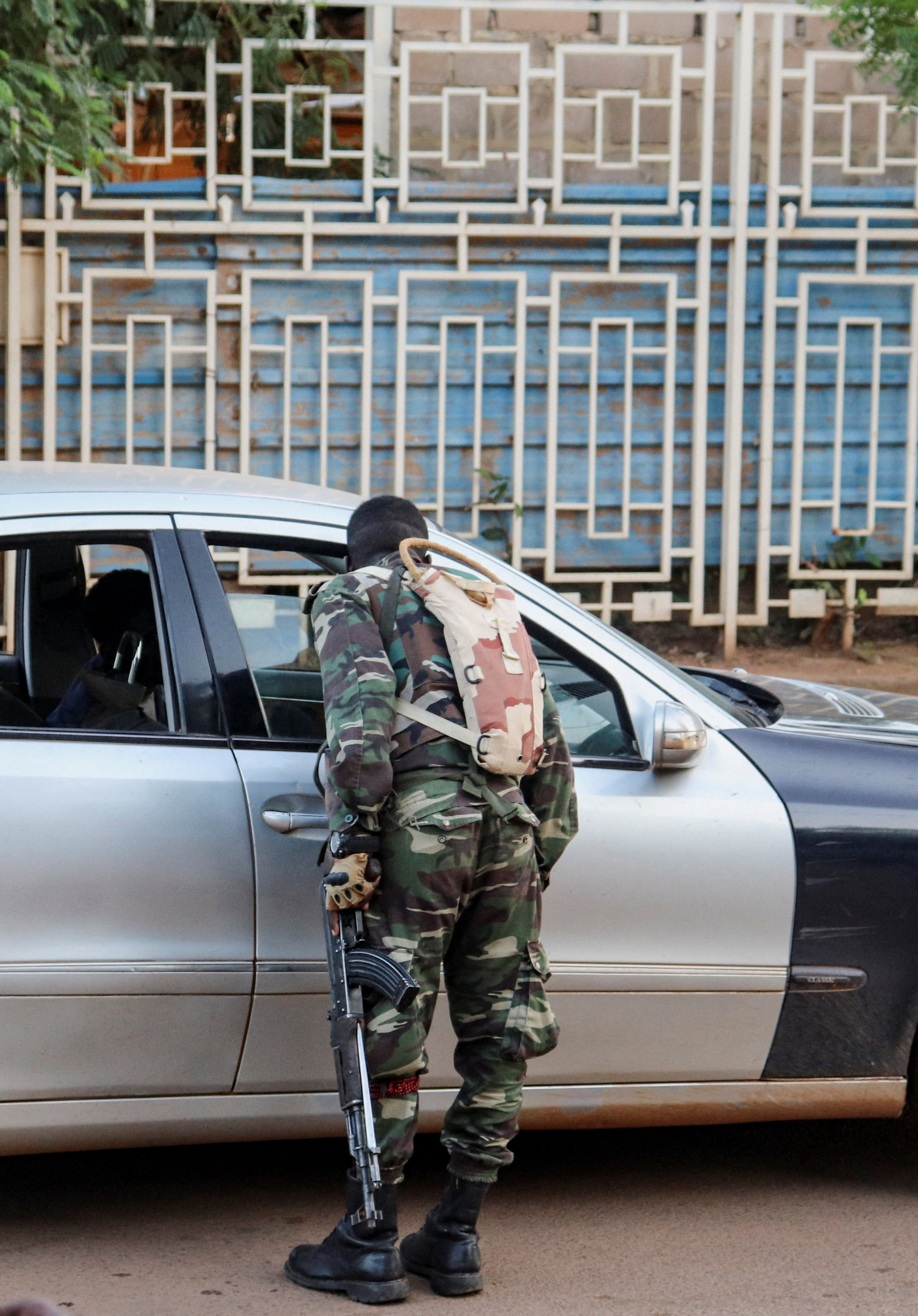
In the latest turmoil to hit Niger in West Africa, the military-led government says it has contained a mutiny in the capital, Niamey, after hours of gunfire and explosions near key military and government sites.
A military base at Diori Hamani International Airport was first targeted on Saturday by renegade soldiers, followed by attacks on the state broadcaster and presidential palace.
Recommended Stories
list of 3 items- list 1 of 3Niger military says it is regaining control after attempted mutiny
- list 2 of 3Gunfire, blasts in Niamey as soldiers mutiny in Niger’s capital
- list 3 of 3Tuareg rebels free more Malian soldiers in prisoner swap, sources say
State TV said security forces gradually regained control, while dozens of rebel soldiers were reportedly killed or arrested.
The mutiny is another blow to Niger’s military leadership, which has failed to bring stability to the country since it took over in a coup three years ago. Since then, the military ruler and president, General Abdourahamane Tchiani, has pivoted the country away from the West, including its former colonial ruler, France.
He has forged close security ties with Russia in efforts to tackle the growing threat from armed groups, but that has not deterred fighters linked to al-Qaeda and ISIL (ISIS) from mounting attacks.
So what happened, who was behind the mutiny, and what does it mean for Niger’s military government?
What happened?
The attacks started shortly after midnight on Saturday at Base 101, a major military facility inside Niamey’s international airport complex previously used by United States forces.
General Salifou Mody, Niger’s defence minister, said a group of soldiers detained some of their comrades and opened fire at “certain sensitive sites” in the capital.
The fighting lasted for several hours, during which the state broadcaster was temporarily taken off air, while gunfire and explosions were reported around the airport and presidential palace.

Authorities said security forces responded quickly and helped regain control. The ruling military council, known as the National Council for the Safeguard of the Homeland, urged people to remain calm.
“Our Defence and Security Forces are mobilised for the Defence of the Fatherland. Let us remain united, vigilant and supportive,” it said.
By late Saturday, military authorities and state TV said the mutiny had been contained. Dozens of soldiers had been killed or arrested. Africa Corps, the Kremlin-backed force, received a request for assistance in neutralising the mutineers in the capital, said Viktor Voropaev, the Russian ambassador to Niger, in an interview with TASS news agency on Saturday.
Africa Corps is a Russian state-controlled paramilitary organisation established by the Russian Ministry of Defence, replacing and absorbing the African operations of the privately run Russian militia, the Wagner Group.
The whereabouts of military leader Tchiani have not been confirmed.
Base 101 houses the general staff of the unified force of the Alliance of Sahel States (AES), which includes Niger, Mali and Burkina Faso. The AES was established in 2023 to combat armed rebellion in the Sahel region.
It also houses the headquarters of the Africa Corps, which supports Sahel states in combating armed groups.
Who were the renegade soldiers behind the mutiny?
The mutineers appear to have included young soldiers from areas outside Niamey, particularly the southwest of Niger.
Reuters news agency reported that the operation involved soldiers from Ouallam, Tera and Dosso, citing analysts and security officials. Troops from those areas have suffered heavy losses fighting armed groups, particularly the regional ISIL affiliate.
The exact size of the mutinous force, and who led the mutiny, was not immediately clear. But analysts said the involvement of front-line troops points to growing frustration within the military.
“These mass-casualty overrun attacks on the Nigerien military are becoming commonplace and will continue to fuel unrest and aggravate tensions within the army ranks,” said Heni Nsaibia, senior West Africa analyst at Armed Conflict Location and Event Data Project (ACLED).

Timeline of unrest in Niger
July 2023 – Niger’s military government seizes power in a coup, saying the elected government had failed to contain armed groups.
August 2023: Regional bloc the Economic Community of West African States (ECOWAS) imposes sanctions and threatens military intervention; Tchiani proposes a three-year transition.
September 2023: Niger, Mali, and Burkina Faso establish the Alliance of Sahel States (AES). France agrees to withdraw its ambassador and 1,500 troops.
January 2024: Niger, Mali, and Burkina Faso announce their withdrawal from ECOWAS.
June 2024: An attack in western Niger kills 20 soldiers and a civilian, one of the deadliest assaults on the military since the coup.
September 2024: Niger suspends its military pact with the US. Washington subsequently withdraws its troops and closes its two bases – Air Base 101 in Niamey and Air Base 201 near the northern city of Agadez. Built at a cost of more than $100m, Air Base 201 was used for manned and drone surveillance flights and other operations in efforts to target ISIL fighters and Jama’at Nusrat al-Islam wal-Muslimin (JNIM), a regional affiliate of al-Qaeda.
October 2025: Kevin Rideout, a pilot with the evangelical missionary agency SIM International, is abducted in Niamey.
January 2026: ISIL claims responsibility for an attack on an air force base at Niger’s Diori Hamani International Airport and the adjoining military base in Niamey.
June 2026: An armed attack on Niamey airport kills 11 soldiers and two civilians.
August 29, 2026: Soldiers mutiny at Niamey’s Base 101, with gunfire around the airport, presidential palace and other sensitive sites.
Why is there unrest in Niger?
Niger’s military invoked increasing armed violence to seize power in the 2023 coup. It accused the elected government of failing to quash armed rebellion.
However, three years later, armed groups remain a major threat – fighters affiliated with al-Qaeda and ISIL have continued to carry out attacks.
The military-led government boosted its ties with Russia as Niger told France and the US to withdraw their forces. Niger has also joined Burkina Faso and Mali in the AES in order to put up a united fight against armed groups.
Nevertheless, the shift has not stopped unrest. The repeated attacks and heavy military casualties have fuelled frustration among front-line troops.
ACLED’s Nsaibia described the mutiny as a sign of a wider problem.
“Deteriorating insecurity drove the coups that swept across the central Sahel, and the latest events show how these same pressures are now fuelling unrest within the militaries that seized power,” he said.
What has been the response of the international community?
The AES expressed support for Niger’s military leadership, saying in a statement that the mutineers had been “contained and thwarted”, calling the mutiny a “betrayal by a group of soldiers involved in a destabilisation plot”.
It was unclear whether Mali or Burkina Faso provided direct military assistance to their ally.
Algeria condemned the events and expressed its “full solidarity and firm support” for Niger.
Turkiye’s Foreign Ministry called for restraint and posted on X that it hoped “calm would be restored as soon as possible” while pledging to continue supporting Niger.
Why did the attack happen, and what comes next?
The mutiny “speaks of deeper institutional and structural challenges within the military”, Kabir Adamu, an Abuja-based security expert, told Al Jazeera.
There is an argument that “persons who have received significant training, both within and outside [the military], are now occupying political positions and are not on the front line where they are needed to address the complex security challenges facing the country”, he said.
There are also the issues of equipping and rotating military forces.
“The grievances grew to a point where this mutiny sort of occurred,” said Adamu, the managing director at Beacon Security Innovations, adding: “As part of that mutiny, based on the places they targeted, it was clearly an attempt to overthrow the government.”
“If [Tchiani] does not address the deep-rooted socioeconomic, cultural, environmental and security challenges that he promised when he took over power in July 2023, then those issues will continue to rear their head,” Adamu said.
Rida Lyammouri, a senior fellow and Sahel expert at the Policy Center for the New South, based in the Moroccan capital Rabat, says Niger’s military leadership has devoted resources to protecting its grip on power rather than addressing the country’s security and other challenges.
The Africa Corps, Lyammouri pointed out, has been paid to fight groups affiliated with al-Qaeda and ISIL (ISIS), but instead, the Russian group has been used to protect the military during the “recent coup” attempt.
Lyammouri warned against growing threats from armed groups, with some of them also expanding into new areas along Niger’s borders with Benin and northeast Nigeria.
“There are no clear signs of the military bringing stability and security to the country, as they promised following the coup they carried out in 2023,” he told Al Jazeera.
