Ahmad Hassoun, al-Assad’s ‘barrel bomb mufti’, sentenced to life in prison
Who is Ahmad Hassoun, the ‘barrel bomb mufti’ close to the inner circle of the Assad regime?
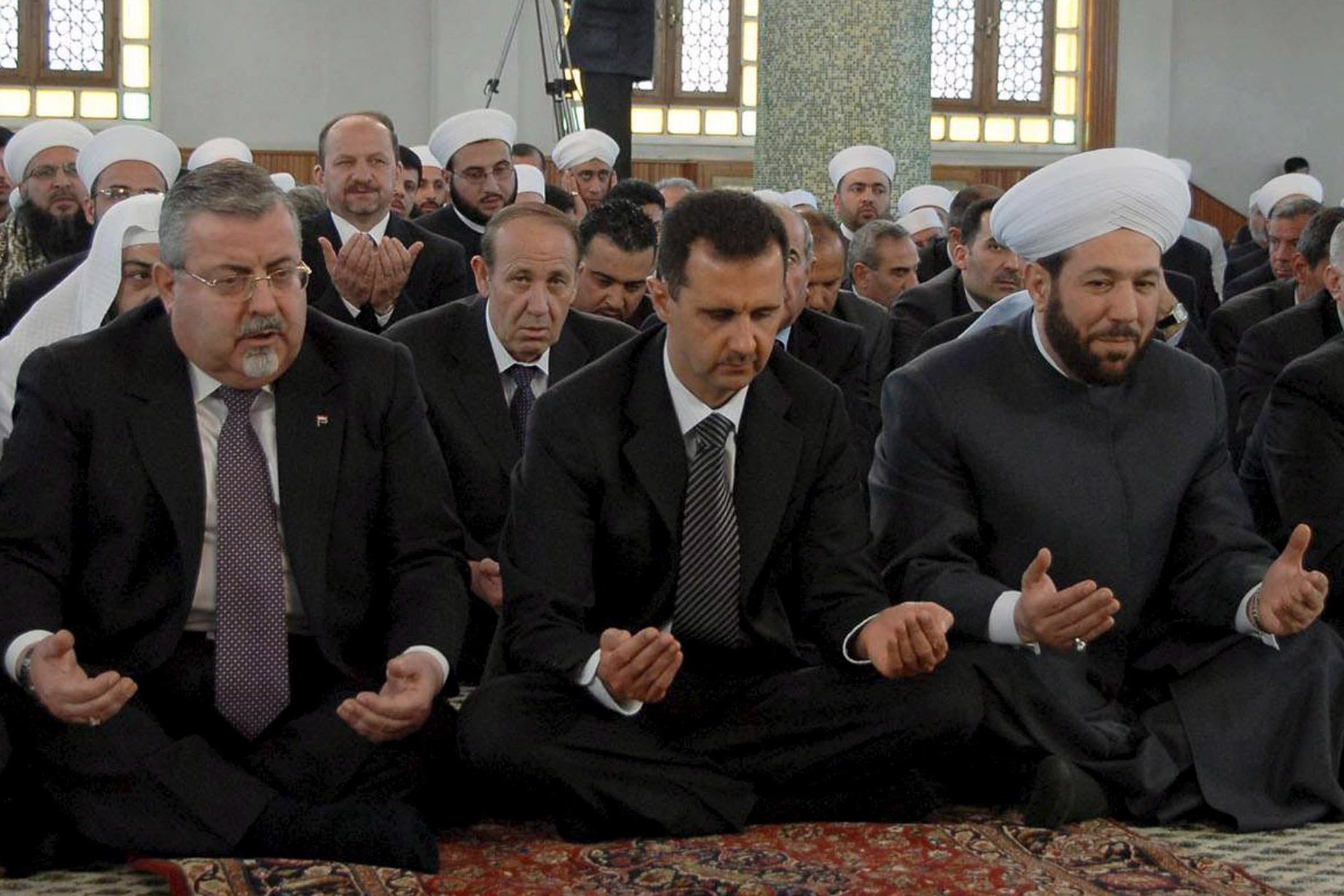
Ahmad Badreddin Hassoun, a top Muslim religious figure during former Syrian President Bashar al-Assad’s rule, was sentenced to life in prison after being found guilty of crimes including inciting violence, justifying killings and the abuse of his office.
On Monday, Judge Fakhr al-Din al-Aryan from the Fourth Criminal Court in Damascus sentenced Hassoun to life in prison for crimes that incited hatred and contributed to the deterioration of the situation during Syria’s nearly 14-year civil war. The court also handed the religious figure several prison sentences on various other charges.
Hassoun’s trial began on June 25, after he was detained at Damascus airport in March 2025, following his emergence from hiding a month earlier.
Hassoun, who was Syria’s grand mufti between 2005 and 2021, is known for using dehumanising language against opponents of the former government and is believed to have built deep ties with state and security officials during al-Assad’s rule. Prosecutors had called for a death sentence.
Here is everything you need to know about the controversial Muslim scholar.
Who is he?
Hassoun was born in Aleppo in 1949. His father was a prominent sheikh.
He delivered sermons locally in Aleppo and served in parliament from 1990 to 1998.
In 2005, he was appointed by former Syrian President Bashar al-Assad as Syria’s grand mufti, where he was known for supporting interfaith dialogue and the separation of religion and state.
When the 2011 Syrian uprising began, Hassoun threw his weight behind al-Assad, blaming foreign countries for meddling in Syria’s affairs and supporting what he called “terrorism”.
Critics labeled him the “barrel-bomb mufti” for his fervent support for the regime and violent rhetoric against its opponents. His son was assassinated in 2011.
Hassoun delivered a series of controversial statements that diminished his popularity and political stature. Al-Assad, without explanation, abolished the grand mufti position in 2021.
When al-Assad’s government fell in December 2024, Hassoun went into hiding. There were rumours he had fled Syria, but he was arrested at Damascus international airport in March 2025 as he tried to board a flight to Amman, Jordan.
Why did he rise to prominence?
Hassoun was known for his Friday sermons in Aleppo and his role as a loyalist to the Assad government during his eight years in parliament.
Hassoun’s appointment as the grand mufti of Syria is generally considered to be due to the Syrian government seeing him as compliant and non-threatening.
Hassoun fell out of favour with the regime even before it was toppled in December 2024. This is believed to be due to his reported business partnership with al-Assad’s billionaire cousin Rami Makhlouf, who was stripped of his business holdings by the government in 2020.
He was also viewed as lacking the scholarly gravitas of many other Sunni religious figures.
What were his most controversial fatwas or declarations?
Hassoun threatened European countries in a 2011 televised speech, warning that if they attacked his country, Lebanon and Syria would respond by training their citizens to become suicide bombers.
He openly supported Iranian and Russian intervention in support of al-Assad, and praised Islamic Revolutionary Guard Corps Quds Force commander Qassem Soleimani, who oversaw Tehran’s forces in Syria.
Soleimani was widely disliked among Syrians for his role in supporting al-Assad. Hassoun called him a pious man who “only fights in a place where the enemies of God and humans are: he never lifted his hand against any Muslim; he never lifted a weapon in the face of any Muslim”.
According to Amnesty International, Hassoun was deputised by al-Assad to approve prisoner executions in the infamous Sednaya prison, north of Damascus. Between 2012 and 2017, he reportedly approved the executions of 13,000 inmates.
The final straw apparently came at the funeral services of the Arab icon, Syrian singer Sabah Fakhri, when Hassoun claimed that a passage in the Quran meant that God created humanity in Syria and blasted refugees who had fled the country. Shortly thereafter, the position of grand mufti was abolished in Syria; it was reestablished following the fall of al-Assad.
What was Hassoun on trial for?
Hassoun faced wide-ranging charges including inciting violence and providing religious and political legitimacy for the Assad regime and allies and militias that fought on its behalf.
Evidence against Hassoun presented during his trial included his alleged ties to the inner circles of the former Syrian government, in a professional but also personal capacity. This includes al-Assad and the notorious former intelligence chief Ali Mamlouk.
He was also accused of having ties to senior army officers and militia leaders allied with al-Assad.
Prosecutors also alleged he delivered sermons to the Syrian army in support of the regime and called for violence against areas where opposition groups were based.
He was also accused of inciting violence against civilians and refugees in opposition areas, calling on civilians to evacuate their homes, threatening residents of Idlib governorate with death or displacement, praising regime figures involved in war crimes – including the former Syrian Republican Guard commander, Brigadier General Issam Zahreddine – supporting Russian and Iranian intervention in massacres against Syrians and supporting Soleimani and his involvement in war crimes in Syria.
What have other recent trials in Syria revealed?
Bashar al-Assad, his brother Maher, and cousins Wassim al-Assad and Atef Najib were all recently sentenced to death. The Assad brothers, who fled to Russia after rebels took Damascus in December 2024, were tried in absentia.
