Hundreds of thousands protest across France in strike over wages
About 600,000 people take part in nearly 200 demonstrations across the country, Interior Ministry says.
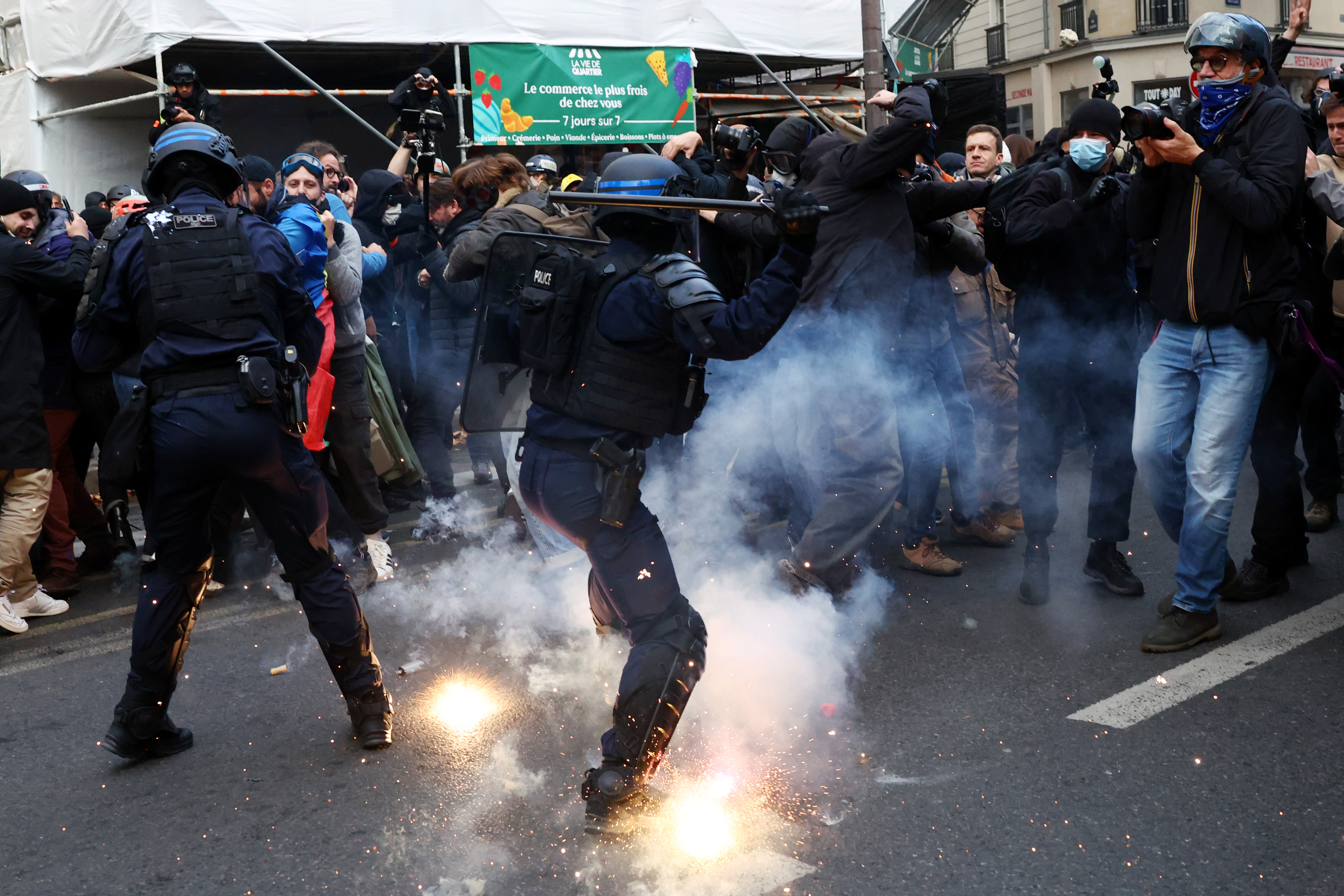

Hundreds of thousands of workers have gone on strike and joined marches across France to demand higher wages, in a new escalation after weeks of protests against the rising cost of living, with police firing tear gas as violence broke out in some cities.
About 600,000 people took part in nearly 200 demonstrations across the country on Thursday, according to the Ministry of the Interior, before a major march began in the capital, Paris.
Recommended Stories
list of 3 items- list 1 of 3Danish students join European protest wave against education funding cuts
- list 2 of 3France opens ‘attempted murder’ probe into petrol bomb attacks on police
- list 3 of 3Student protests resume in France as pupils return to school
Those striking are demanding an increase in the minimum wage, higher salaries for all workers, tax reforms and better conditions in schools.
Education, rail, hospital and postal unions called strikes, and the Ministry of National Education said about 16 percent of teachers were on strike.
The Eiffel Tower and the Arc de Triomphe were closed for the day. CGT union leader Sophie Binet told the Paris rally that the question was not whether workers would win but “how much we’re going to win”.

France has seen regular protests since September, when students began demonstrating against poor conditions at public high schools.
The movement has since merged with wider anger about the cost of living and inequality, which led to the worst rioting in years on October 17. The government reported blockades at 81 of 3,700 high schools, and a student association said classes were suspended at 1,000.
At the protest in the northern city of Lille, Hugo, a history student, told Al Jazeera that he was angry about the social situation in France.
“The workers are angry that wages are too low, life is getting more and more expensive and in the universities and high schools, we can feel the lack of public services. So, there is a common anger in the country, and that’s why I am here today. I’m angry about this social situation,” he said.
“There is money in the society, but it’s in the hands of a small group of people, and we have to fight to change the situation,” he added.
In the southern city of Marseille, a 31-year-old social worker named Lea, who spoke with the AFP news agency without giving her second name, said she was fed up with counting her money.
“My basket of 20 items has become too expensive. We’ve got nothing to eat; it scares me. I’m buying lousy products. We want cheaper groceries, cheaper petrol,” she said.
“This social movement gives us hope. It’s been a long time since we’ve seen anything like this,” Lea added.
“I feel like it’s catching on, that there’s a convergence,” said 60-year-old protester Jean-Marc Morel.
“There are a lot of us here, and it’s joyful, it’s diverse. We’ve got all kinds of professions, old people, young people,” he added.

While the marches were largely peaceful, the ministry claimed several hundred masked “black bloc” protesters assembled in Lyon, where tear gas was fired, and at least one vehicle was torched.
There were incidents in Nantes, and a fire broke out at a school near Toulouse after incendiary devices were thrown. In Paris, police used tear gas to stop students blocking a high school.
Interior Minister Laurent Nunez had promised “an extremely firm response” to any violence, with 70,000 police deployed. France has faced criticism for its handling of the demonstrations, with allegations of police brutality prompting internal investigations. Several teenage protesters have been seriously wounded and thousands arrested since the protests began.
The protests come at a crucial time. France is due to elect a new president in April, with Macron unable to run again, and polls suggest far-right candidate Marine Le Pen is the favourite.
The eurozone’s second-largest economy is also trying to redress its finances.
Several European countries, including Germany and Portugal, have seen protests against declining living standards. The news agency Reuters reported that a G7 foreign ministers’ meeting has been moved from Marseille to Paris at the last minute, a move diplomats called “chaotic”.
