Trump heads to China amid Nvidia scandal: Will he get tougher on Beijing?
Outgoing Nvidia chief credited with easing US-China chip ties, but his personal scandal unlikely to upend talks.
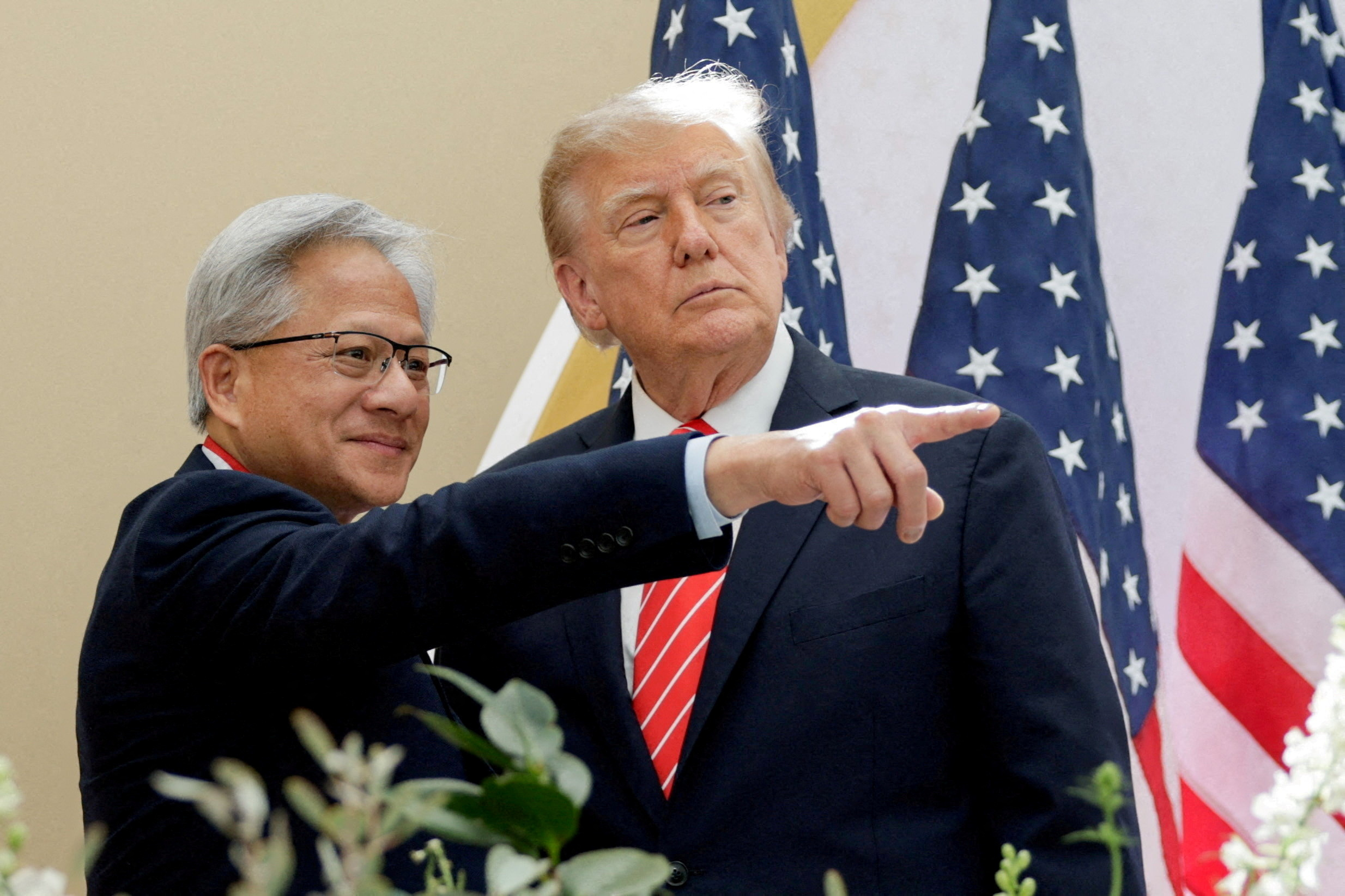
United States President Donald Trump travels to the Chinese city of Shenzhen this week for the Asia-Pacific Economic Cooperation (APEC) summit, where he is due to meet Chinese President Xi Jinping.
The trip comes as Jensen Huang, Nvidia’s outgoing chief executive and one of Trump’s closest allies in Silicon Valley, faces mounting scrutiny over his relationship with Alice Huang, a former executive at the Singapore-based Megaspeed cloud-computing company whom US officials suspect of working for Chinese intelligence. China has denied the allegations.
Recommended Stories
list of 4 items- list 1 of 4US envoys and Putin agree to continue Russia-Ukraine peace talks
- list 2 of 4China says US ‘fabricating’ Nvidia spy claims to justify tech ‘blockade’
- list 3 of 4Xi Jinping says Taiwan’s ‘complete reunification’ with China will happen
- list 4 of 4‘Greater Israel’: Christian Zionism’s role in US policy
On Thursday, Nvidia announced that Huang would step down as its CEO.
Trump addressed the resignation hours later in an interview with conservative commentator Hugh Hewitt. He said it was “a horrible thing” and “so sad to see” but did not elaborate on the allegations.
Trump praised Huang after telling Hewitt the US would be in “bad shape” if it lost its edge in artificial intelligence.
Huang accompanied Trump on Air Force One for his May visit to Beijing.
His presence mattered for Nvidia, which has struggled to secure approval to sell its H200 AI chips in China. Now, his place in the next delegation is in doubt. And Democrats in Congress have raised questions about Trump’s close relationship with Huang.
So could the backlash push Trump’s administration towards a tougher line on China? Here’s what you need to know:
How did Huang shape the US-China chip thaw?
As cofounder and CEO of Nvidia, Huang pushed Washington to ease restrictions on the sale of advanced chips to China, arguing that wider use of US technology would help it hold on to its lead in AI development.
In December, Trump did approve sales of the H200, Nvidia’s second-most powerful chip, to China with 25 percent of proceeds to be paid to the US government.
He did so despite opposition from China hawks in both the Republican and Democratic parties.
Huang was a surprise late addition to Trump’s delegation to Beijing in May. Despite Trump’s decision to allow the H200 sales, shipments were low because of slow import approvals from the Chinese government in a bid to support domestic chipmakers. No breakthrough was announced.
Trump has stood by Huang throughout his recent personal scandal, calling him an “honourable guy”.

Will the Nvidia scandal prompt Trump to take a tougher stance on China?
Not immediately.
Huang’s removal from Nvidia’s board, the loss of his CEO post and the scandal leading up to that are unlikely to significantly affect relations between Washington and Beijing, which Steve Okun, a Singapore-based geopolitical analyst, told Al Jazeera is “a stalemate at best”.
Instead, if the US continues to impose restrictions on AI product sales to China, AI diversion and diffusion – how products are traded around the world both formally and informally – would be much more likely to cause tensions between the two nations.
Gabriel Wildau, managing director at the advisory firm Teneo, told Al Jazeera that Trump “shows no sign that he intends to disrupt the current US-China rapprochement”.
But he warned that the president “may face new pressure from Congress and hawkish voices inside his administration”.
Carsten Holz, an expert on the Chinese economy at the Hong Kong University of Science and Technology, said Trump “would not seem to have a coherent China policy and, therefore, his position in the upcoming talks in Shenzhen is hard to predict”.
Huang’s personal affairs “will be of little relevance” to China-US relations, he told Al Jazeera.
Where is the pressure to be tougher with China coming from?
Mostly from Congress, where control of both houses will pass to the Democrats on January 3.
Lian Jye Su, chief analyst at the technology research group Omdia, said a tough US line on AI and China was not Trump’s alone, calling it “one of the rare political consensuses domestically across the aisle”.
Trump, he said, “will do whatever he can to protect his contribution and legacy on this matter”.
On Wednesday, Democratic Senators Elizabeth Warren and Chris Coons asked Commerce Secretary Howard Lutnick, Secretary of State Marco Rubio and White House chief of staff Stephen Miller to preserve all records on Nvidia’s chip exports to China.
“This incident raises significant concerns about the federal government’s ability to effectively enforce our export controls and protect our national security,” the senators wrote.
The news website Axios reported that Lutnick had held up a planned crackdown on firms suspected of funnelling Nvidia chips to China.
Meanwhile, procurement notices seen by the AFP news agency showed that a Chinese university linked to the country’s defence establishment bought Nvidia H200 chips through a third party in September and October.
How has China responded?
Beijing has rejected the spy claims and accused Washington of using them as cover to impose stronger restrictions and semiconductor export controls on China.
“The US side should stop fabricating such ‘spy’ narratives as a pretext for imposing a technological blockade,” Ministry of Foreign Affairs spokesperson Mao Ning said on Thursday.
But Mao also said China is willing to work with the US to implement the consensus reached by the two leaders.
Su said China “has no interest in not engaging with Trump, given substantial interest in Nvidia graphics processing units”.
Chinese chipmakers may also gain from better access to US technology.
Shares in Moore Threads, MetaX and Cambricon, China’s leading makers of graphics processors, jumped nearly 10 percent on Thursday.
What happens after Shenzhen?
Holz, the Chinese economy expert, noted that the use of advanced Nvidia chips in Singapore data centres to serve customers in mainland China was “not new information”.
Still, Okun expected the pressure to build next year.
He said Congress could pass the Remote Access Security Act, aimed at stopping Chinese firms from reaching advanced chips through the cloud.
The US Department of Commerce, he added, could put export controls on Megaspeed or require licences for advanced chips sent to countries such as Singapore and Malaysia.
If that happens, it will strain the US-China relationship in 2027, he said, adding: “But that’s not going to happen next week.”
